.png)
Lexora
Designing an AI Legal Assistant for Everyone
Overview
Lexora is an AI-powered legal assistant that translates complex Indian legal language into clear, human-centered answers. Built on a Retrieval-Augmented Generation (RAG) architecture trained on the Indian Penal Code (IPC) and related statutes, Lexora allows everyday Indian users not just lawyers to ask legal questions in plain English and receive accurate, context-aware responses grounded in Indian law.
The product was designed and built end-to-end: from initial user research through UI design, frontend implementation, and deployment. This case study documents the full process the thinking, the decisions, and the tradeoffs.
Timeline
2024-2025
Tools
Figma · FigJam · Visual Studio Code · Streamlit
My Role
Product Designer · Frontend Developer · Interaction Architect
Methods
User Interviews · Competitive Analysis · Usability Testing · Iterative Design
Problem
Legal knowledge is a privilege in India, not a right
India has one of the most complex legal systems in the world: a layered mix of colonial-era British statutes, post-independence legislation, state-level laws, and a judiciary with over 40 million pending cases. The Indian Penal Code, Consumer Protection Act, Rent Control Acts these are the laws that govern the everyday lives of 1.4 billion people. Yet they are written in dense legal English that is effectively inaccessible to most citizens. The result is a massive gap between people's legal rights and their ability to exercise them.
Process

Discover
-
Understanding
-
Problem Space
-
User Interviews
-
Competitive Analysis
-
Secondary Research

Define
-
Focus
-
Persona
-
Affinity Mapping
-
HMW Questions
-
Design principles
-
Constraints

Develop
-
Explore
-
Information Architect
-
Wireframes
-
Prototypes
-
Iteration

Deliver
-
Frontend Development
-
Final UI
-
Shipping
-
Validating
-
Deployment

Test
-
Testing
-
Feedback
-
Thoughts & suggestions
Discovery: Research & Understanding
Competitive Analysis
Before talking to users, I mapped the existing landscape to understand what tools already existed and where they fell short. I analysed five products across dimensions most relevant to Lexora's target users: Indian law specificity, plain-English output, conversational interface, and cost.
No existing product combines Indian law specificity + plain-English conversational answers + free access. This is the white space Lexora is designed to occupy.
.png)
Define: Focus & Personas
User Research - 8 Interviews; 3 Segments:
I conducted 8 semi-structured interviews across three distinct user segments, each representing a different relationship with Indian law. Interviews lasted 30-45 minutes and were conducted remotely. I used FigJam to synthesise findings using affinity mapping.
Five consistent themes emerged across all interviews:
-
Plain English first, users opt out the moment the first sentence is confusing.
-
Trust needs sourcing, the moment a response cited a specific IPC section, trust increased sharply.
-
Conversation beats forms users think in questions ('Can my landlord do this?'), not categories.
-
Context is everything: an answer without knowing the state or situation type is often useless.
-
Speed is non-negotiable more than 2 interactions to get an answer and users go back to Google.
User Personas:
How Might We Questions
HMW questions were derived directly from the research themes. These became the brief that guided all design decisions.
-
How might we make IPC and Indian statute answers readable without stripping out accuracy?
-
How might we build user trust in AI-generated legal information without overwhelming them with caveats?
-
How might we help users who don't know what legal question to ask only that they have a problem?
-
How might we handle AI uncertainty gracefully so users are never misled by low-confidence answers?
-
How might we serve users across wide literacy and legal knowledge levels using one interface?

.png)
Develop: Flow & Architect
User Flow
Lexora opens with a minimal home screen a centered input bar and a curated set of example prompt cards that invite the user in without overwhelming them. Tapping a card auto-fills the query, lowering the barrier to entry. On submit, a subtle loading state reassures the user while the answer is being generated. The response is presented in a layered layout: a concise summary leads, followed by an expandable full answer, with tappable citation chips anchored at the bottom that reveal source text in a clean modal overlay. A disclaimer and a persistent "Ask a follow-up" button remain fixed on screen, keeping the conversation feel alive. Post-answer, four lightweight action buttons copy, save, export as PDF, or new query sit unobtrusively at the bottom, letting the user decide their next move without friction.
.png)
Design Principles
Four principles were established before any pixel was designed. Every subsequent decision was evaluated against these:
-
Clarity First: No legal term appears without an immediate plain English explanation.
-
Transparent AI: The system's limitations are always visible, never buried in fine print.
-
Progressive Depth: Short answer first, full legal detail available on demand.
-
Conversational Trust: Tone of a knowledgeable friend, not a law firm.
Lo-Fi Wireframes
To visualize the initial concept, I created low-fidelity wireframes that mapped out the entire structure. These wireframes focused on layout, navigation flow, and core functionality, ensuring that key pain points were addressed before moving to high-fidelity designs.
.png)
.png)
Hi-Fi Wireframes
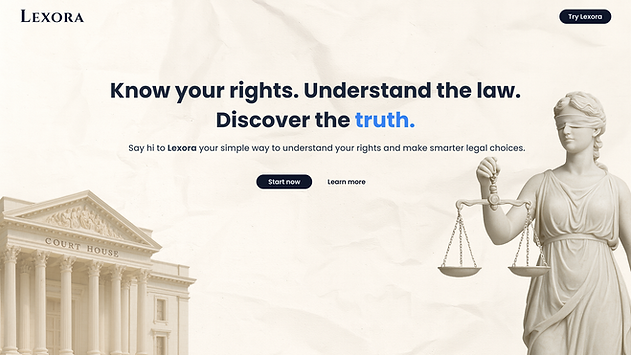
The final product reflects every research insight, iteration decision, and testing finding documented above. Key screens:
.png)
.png)
.png)
Test: Feedback & Suggestions
Usability testing for Lexora was conducted across three iterative rounds with a total of 5 to 8 participants per round, using a think-aloud protocol where users verbalized their thoughts while interacting with the product in real time. Each round was directly tied to a design iteration participants were given realistic legal query scenarios and asked to navigate the product without guidance, allowing the team to observe natural behavior, hesitation points, and decision-making patterns. Sessions were evaluated for task completion, time-to-first-query, drop-off behavior, and post-session verbal feedback, with findings from each round directly informing the next design change before the subsequent test was conducted.
.png)
.png)
.png)
.png)
Quantitative Findings (Measure Impact):
Qualitative Findings
Navigation Artifact: 60% of users ignored the category selector entirely, revealing it as a friction point that contradicted Lexora's conversational assistant identity.
False Helpfulness: The selector appeared useful on the surface but actively disrupted natural query flow a classic case of feature bloat masking as onboarding support.
Safety-Critical Blind Spot: 60% of participants never noticed the footer disclaimer, and one user explicitly intended to act on Lexora's output without consulting a lawyer.
Design Responsibility: In a legal-domain AI product, disclaimer placement is not a compliance checkbox it is a core trust and safety mechanism that the UI must actively enforce.
Highest-Value Drop-Off: One participant refreshed mid-response the most costly moment to lose a user, when the AI had already done the work but the UI failed to communicate it.
Transparency as Retention: Without visible system feedback, user confidence collapses regardless of how accurate or fast the underlying model actually is.
Result:
Users completed all tasks without guidance: 8/8
Average satisfaction score: 4.6/5
Noticed and read the disclaimer: 7/8
Deployed & publicly accessible: Live
Next Steps:
-
Document upload, clause-by-clause analysis for rental, employment, and vendor agreements.
-
State-level law coverage, Maharashtra, Delhi, Karnataka, Tamil Nadu as first expansion. Hindi and regional language support removing the English literacy barrier for deeper reach.
-
Judgment prediction feature using Bi-GRU model trained on historical case data. First-run onboarding experience with guided example query.
-
Partnership with legal aid NGOs and district courts for free citizen access. Mobile-first redesign optimised for low-bandwidth Indian users on smaller screens.
.png)